Aligning Values and Actions
There’s a quiet tension that builds when your life starts drifting out of alignment with what actually matters to you.
It doesn’t usually arrive with a dramatic breakdown. It’s subtler than that. It shows up as restlessness. A low-grade dissatisfaction. A sense that you’re capable of more—but somehow still circling the same patterns, the same decisions, the same version of yourself.
At the core of that tension is misalignment: your actions no longer reflect your values.
And the longer that gap persists, the louder it gets. This month, were going to bring that into alignment.
Alignment isn’t abstract—it’s behavioral
It’s easy to say you value growth, honesty, freedom, creativity, or courage. Most people do. The real question is: are your daily actions backing that up?
Because alignment isn’t something you think about—it’s something you do.
If you value growth, but consistently choose comfort, there’s a disconnect.
If you value freedom, but stay in situations that quietly drain you, your life starts to feel smaller than it should.
Alignment requires friction. It asks you to make decisions that feel inconvenient in the short term but true in the long term. It requires a bit of discomfort. And that’s where most people hesitate.
The comfort zone is convincing—but costly
Comfort is persuasive because it feels safe, predictable, and controlled. You know how things work there. You know who you are there. You literally feel comfortable. But not fulfilled.
Comfort has a hidden trade-off: it keeps your life contained.
Nothing expands without stepping into the unknown. Not your confidence, not your identity, not your opportunities.
The unknown, by contrast, is uncomfortable by design. It introduces uncertainty, risk, and the possibility of failure. But it also holds every version of your life that doesn’t yet exist. A beautiful, successful, more joyous version.
You don’t “feel ready” before you move into it. You move, and readiness catches up later.
Breaking out of comfort isn’t about reckless action—it’s about deliberate discomfort. Taking the step you can’t fully predict. Saying yes to something that stretches your current identity. That’s where alignment starts to rebuild.
Limiting beliefs: the invisible ceiling
What keeps most people anchored in comfort isn’t just habit—it’s belief.
Specifically, limiting beliefs that quietly define what feels possible:
- “I’m not the kind of person who does that.”
- “It’s too late for me to change.”
- “I need more certainty before I act.”
- “If I try and fail, it will mean something about me.”
These beliefs aren’t facts—they’re interpretations that have been repeated enough to feel true. They’re subtle comments and “friendly” steering we’ve been internalizing for decades.
And they shape behavior more than reality does. The problem is, you can’t expand your life while operating inside assumptions that are designed to keep it small.
Breaking free isn’t about force—it’s about evidence
You don’t dismantle a limiting belief by arguing with it. You dismantle it by collecting evidence against it and rallying against the outside forces that would hold you back.
Small, consistent actions that contradict the story:
- Speaking up when you’d normally stay quiet
- Trying something before you feel fully prepared
- Making a decision without overanalyzing every outcome
- Letting yourself be seen in a new way
Each action creates a crack in the old narrative.
Over time, those cracks compound. The belief loses credibility—not because you forced it out, but because your lived experience no longer supports it.
That’s how identity shifts happen.
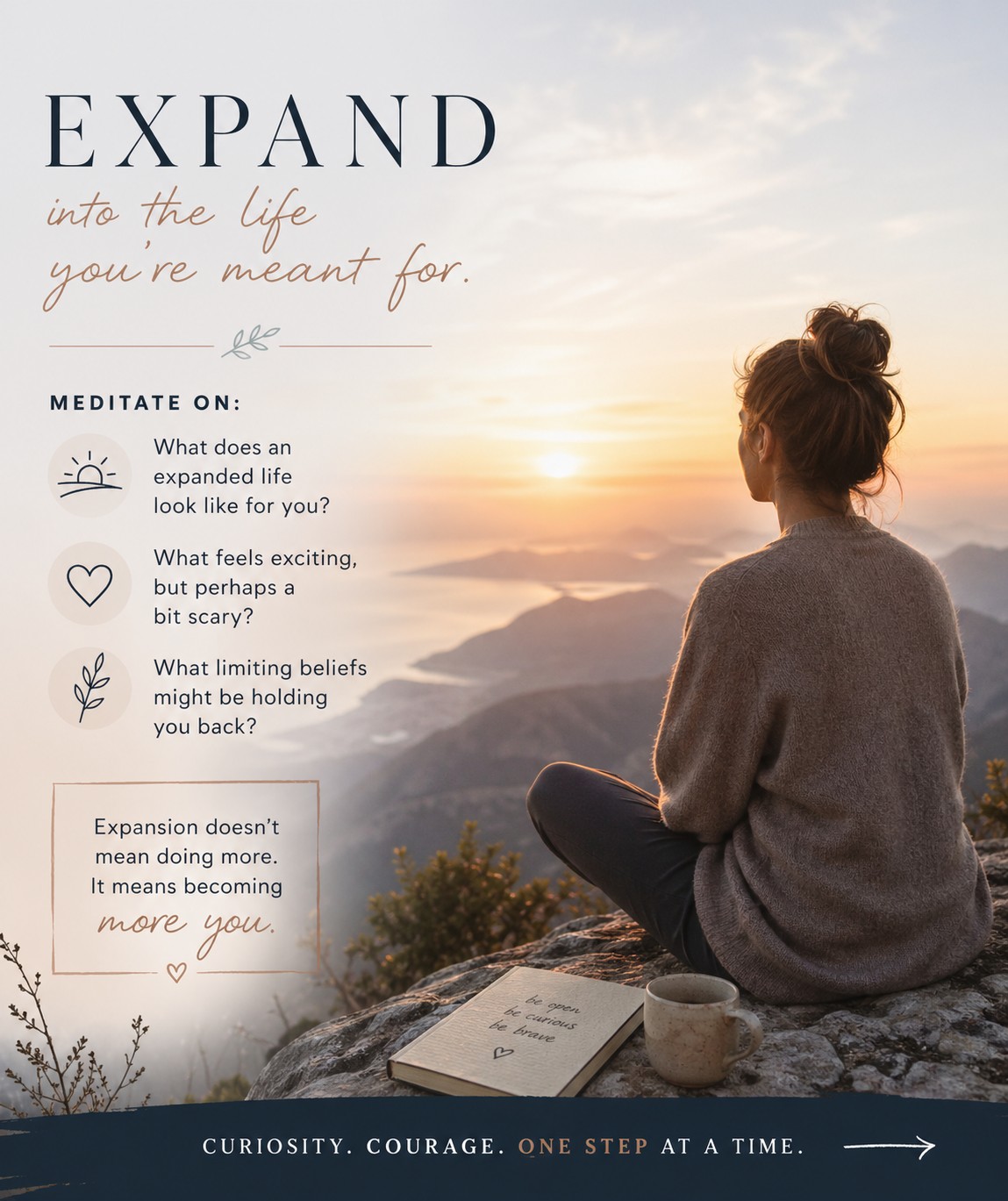
What expansion actually feels like
There’s a misconception that expanding your life feels immediately empowering, confident, and clear.
Sometimes it does—but more often, it feels like uncertainty, vulnerability and a loss of control. Expansion isn’t comfortable. It’s disorienting before it’s stabilizing.
But alongside that discomfort, something else starts to emerge:
- A deeper sense of self-trust
- More honest decisions
- A growing tolerance for risk
- Moments of clarity that weren’t available before
- A feeling that your life is becoming yours again
That’s the signal you’re aligning.
Alignment is a continuous choice
There’s no final state where everything is perfectly aligned forever. Life evolves, your values deepen, and new edges appear.
The work is ongoing.
But it gets simpler: you start recognizing the difference between what’s easy and what’s true. And you get faster at choosing the latter.
Not perfectly. But more often.
And that’s enough to change the trajectory of your life.
Because when your actions consistently reflect what matters to you—even when it’s uncomfortable—you stop feeling stuck.
You start feeling in motion.
Enjoy the journey!
Theresa
|